
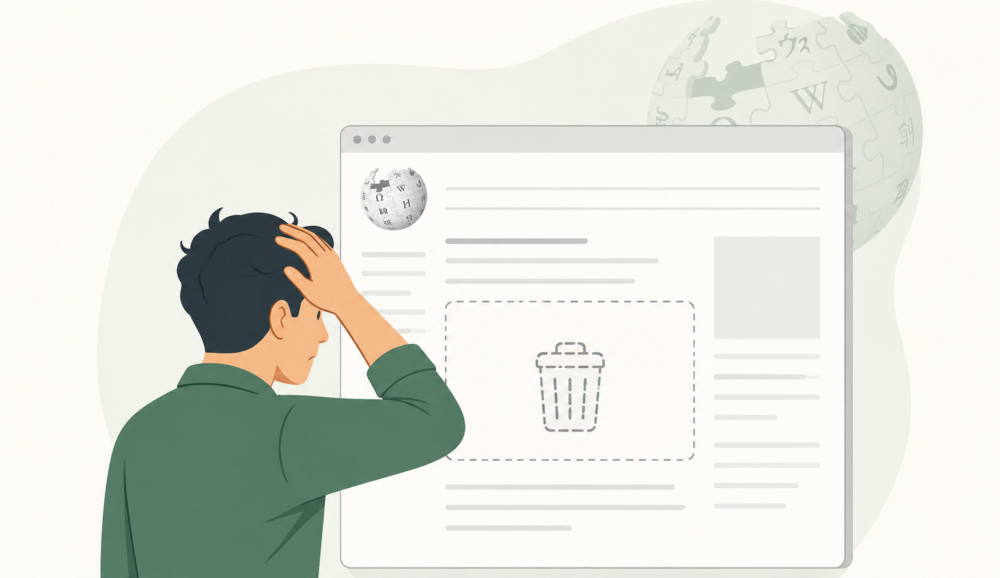
Every day, hundreds of companies and public figures attempt the same thing: writing their own Wikipedia page. And every day, most of those attempts meet the same fate — vanishing within hours, sometimes minutes, flagged as thinly veiled advertising before the author even finishes saving the edit.
This isn’t bad luck. It’s the predictable result of underestimating a system that looks open to anyone but actually runs on strict rules, policed by a community of editors trained to spot exactly this kind of attempt.
The pattern is always the same
Someone writing about their own company almost always makes the same mistake without realizing it: they write to sell, not to inform. They reach for the language of a company website or a press release — achievements, superlatives, mission and vision statements — when Wikipedia demands the opposite: a neutral tone, backed by outside sources with no connection to the company itself.
That mismatch is the first thing a Wikipedia patroller notices, and it’s often enough to get the article flagged for speedy deletion before anyone else even reads it. The system is built precisely for this: spotting, within seconds, text that reads like a press release and separating it from text that reads like an encyclopedia entry.
The tells that give away a promotional article
The text doesn’t need to say “we’re the best” outright to get rejected. Patrollers recognize promotional attempts through far subtler patterns:
- A list of awards, certifications, or milestones with no independent context to validate them
- A near-total absence of critical or neutral mentions, as if the company had never had a weak spot
- Links pointing almost exclusively back to the company’s own website
- A “who we are” corporate structure instead of an encyclopedic narrative
- An editor account created around the same time the article was published — a classic sign of a single-purpose account
Any one of these signals, on its own, might slip through. Together, they trigger review and deletion almost automatically.
Relevance isn’t self-declared
The second, quieter but equally fatal reason for rejection: a lack of independent sources proving the topic actually deserves a place in an encyclopedia. It isn’t enough for a company to exist, turn a profit, or have a social media following. Wikipedia requires evidence of significant coverage from media and publications with no relationship to whoever is requesting the article — and finding, evaluating, and properly presenting that kind of evidence is work that few people get right on the first try.
Many companies confuse visibility with relevance. Thousands of social media followers, paid press placements, or a listing in a business directory don’t add up, in Wikipedia’s eyes, to independent journalistic coverage. That distinction, which sounds technical, is exactly what decides whether an article survives its first week.
Cases that illustrate the problem
The pattern repeats across very different sectors. A small business that drafts its own article leaning only on its corporate site and a couple of paid press notes sees its content removed almost immediately for lack of independent sourcing. An entrepreneur who details a personal career arc in admiring tones, without outside media coverage to back it up, meets the same fate — even when every fact is accurate. A startup that publishes its article right after a funding round, citing only its own press releases, is often flagged for undisclosed conflict of interest, which only makes matters worse.
In every case, the content itself isn’t necessarily false. The problem is structural: it doesn’t meet the neutrality and verifiability standards the community requires before granting a topic a place in the encyclopedia.
A deleted article leaves a mark
What many companies fail to grasp is that a failed attempt isn’t neutral. An article deleted as advertising stays on the record, visible to any editor who revisits the topic later. Later attempts — even well-researched ones — start under suspicion, and rebuilding trust with the editing community tends to be harder than starting from zero.
This creates a perverse effect: the anxiety to “get on Wikipedia as soon as possible” ends up being the direct cause of taking much longer to get there — or of being permanently tagged as a self-promotion attempt.
Wikipedia doesn’t forgive improvisation
In a space where one wrong move at the start can shape everything that follows, the gap between building a stable presence and getting flagged as spam is decided long before the first draft is ever published. It isn’t a matter of poor writing or bad intentions — it’s a matter of understanding a system that rewards neutrality and punishes, almost without exception, any attempt to control your own narrative.


