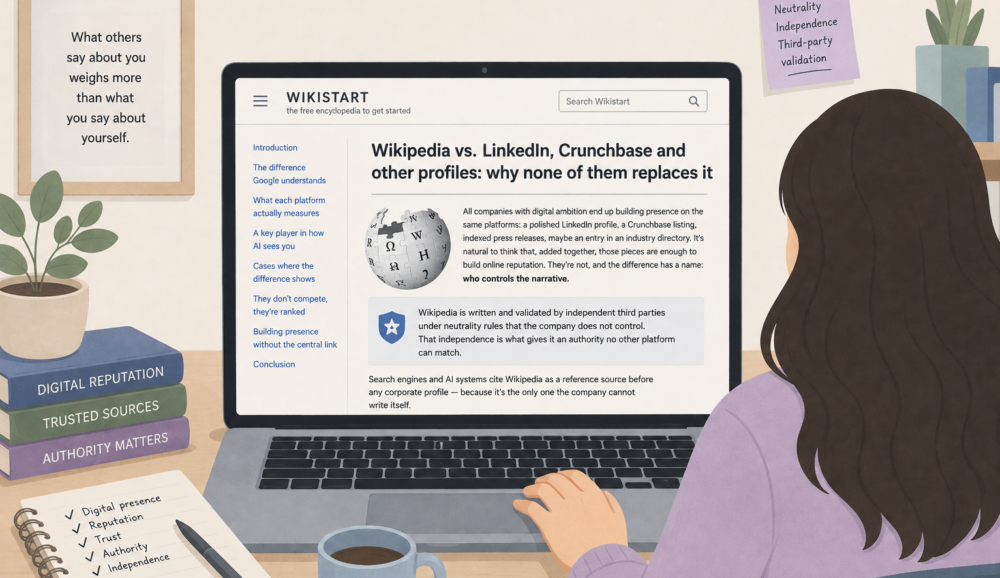
Every ambitious digital brand ends up accumulating a presence across the same handful of platforms: a polished LinkedIn page, a Crunchbase listing, indexed press releases, maybe an entry in some industry directory. It’s tempting to think that, added together, these pieces amount to a solid online reputation. They don’t — and the difference comes down to one question: who controls the narrative.
The distinction Google understands
LinkedIn, Crunchbase, and nearly every business directory share one trait: the content is written, edited, and updated by the company itself. Search engines and AI systems know this, and treat that information for what it is — useful, but self-interested.
Wikipedia works the opposite way. No one can simply “fill out their profile” — the content is written and vetted by independent third parties, under neutrality rules the company doesn’t control. That independence is precisely what gives Wikipedia an authority no other platform can match, and it’s also why search engines and AI systems cite it as a reference source ahead of any corporate profile.
What each platform actually measures
It’s worth understanding what each of these pieces represents within a brand’s digital ecosystem, because they aren’t really competing with one another — they measure entirely different things.
- LinkedIn signals professional activity and network reach, not public relevance
- Crunchbase documents funding and financial data, useful for a narrow audience, not the general public
- Industry directories offer visibility within a niche, but carry little weight outside it
- Paid press releases generate presence, but search engines flag them as sponsored content, not editorial coverage
- Wikipedia, by contrast, certifies that an independent third party considers the topic worth documenting — the only signal on this list the company cannot buy or write for itself
That last distinction is the one search algorithms and language models weigh completely differently from everything else on the list.
A decisive factor in how AI sees you
Increasingly, a brand’s first impression isn’t shaped by a person manually browsing the web — it’s shaped by an AI system summarizing what’s “known” about that company. Much of that knowledge traces back, directly or indirectly, to Wikipedia, which remains one of the most cited and structured training sources in existence. A well-optimized LinkedIn profile doesn’t feed that ecosystem the same way; a stable, well-maintained encyclopedia entry does.
The consequences are concrete. When someone asks an AI assistant “who is” or “what does” a given company do, the answer is highly likely to be shaped, to some degree, by what Wikipedia says — or by the conspicuous absence of that source, which is itself a signal.
Where the difference shows up
A company with an airtight Crunchbase profile but no Wikipedia article often stays invisible to journalists researching a sector, since that kind of listing is rarely cited as a source in editorial coverage. A public figure with a robust LinkedIn and thousands of followers may still be nowhere to be found when someone searches for biographical context, because search engines prioritize sources that don’t depend on the subject itself. And a brand relying solely on paid press coverage risks watching those placements lose indexing and authority over time, while a well-maintained Wikipedia article tends to gain stability and standing year after year.
They don’t compete — they’re ranked
None of this means LinkedIn or Crunchbase are worthless — they serve a real function within a brand’s digital ecosystem and should be kept current as part of any online presence strategy. But treating them as equivalent to Wikipedia is a strategic mistake: they’re channels the company controls, and that’s precisely why they carry less weight with search engines, journalists, and AI systems, which value the opposite — information validated by someone with no commercial stake in the outcome.
Building a presence without the central link
Many brands spend years perfecting each of these channels without realizing they’re building an incomplete digital reputation — one resting entirely on sources they control themselves. The result is a presence that looks solid on the surface but is fragile underneath: the day someone looks for outside validation, that presence has nothing to offer.
Building a digital reputation without Wikipedia is like building a reputation without witnesses: it can be done, but the result never carries the same weight with the audiences that matter most — search engines, journalists, and, increasingly, AI systems.